Historical and
Architectural Features
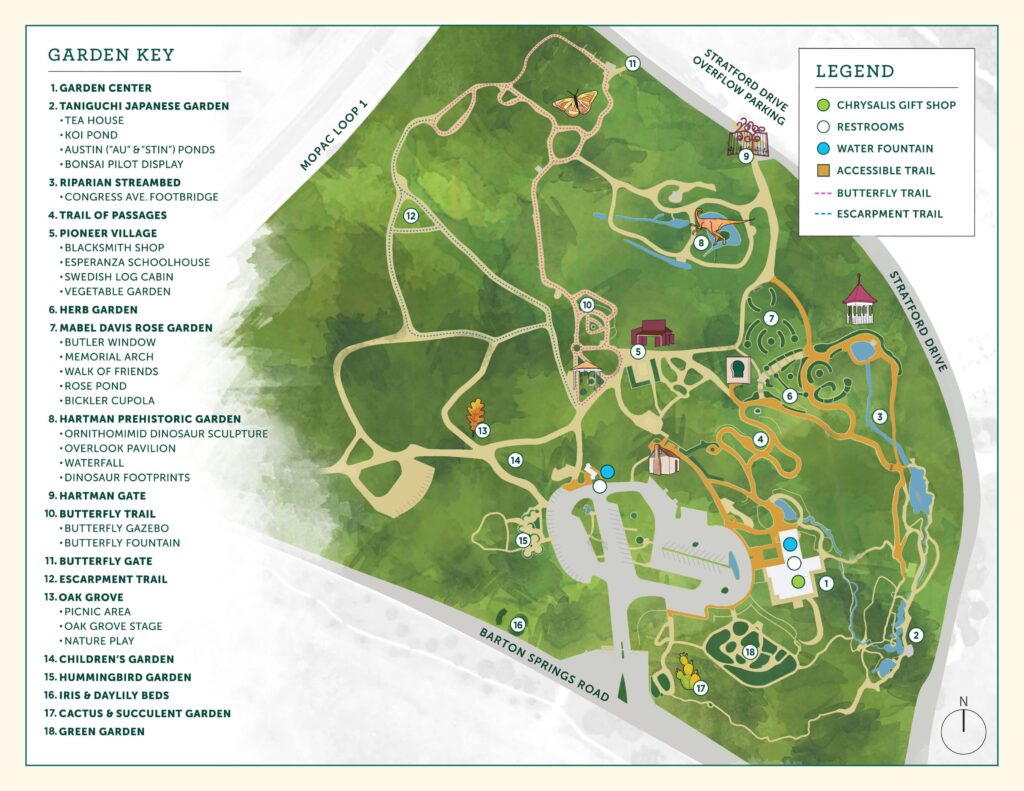
Following the path
from the Japanese Garden to the Rose Garden, you will cross
one of the many artifacts which helped the gardens earn the
reputation as "the attic of Austin". The Congress
Avenue foot bridges were used from 1870 to 1905 when this
main thoroughfare was a dirt road, and bridges were needed
for traversing the drainage ditches.
The
Butler Window is from the home of brick manufacturer Michael
Butler. The unusual key-shaped window was the focal point
of the house built in 1887 at 309 West 11th Street and
contains granite used in the construction of the Capitol.
The window was donated to the Garden Center in 1971 when
the house was demolished.
The Mamie Wilson
Rowe Summer House was bequeathed to the Center by this
long-time resident of Austin. This house was located at
Mrs. Rowe's Austin home at 209 West 10th Street, and moved
here in April of 1968. The Optimistic Garden Club sponsored
the restoration of the house. It is made of cypress wood
and, if you look closely, you may see some of the original
square nails used in construction.
The Antique Light
Standards found in the parking area graced Lavaca Street from
1926 through 1976. In 1975, the City of Austin Electric Department
donated them as a Bicentennial Project and the Austin Area
Garden Council donated funds toward their installation.
|
| |
| The beautiful
iron entry gates were dedicated in 1996. Local craftsmen
Lars Stanley and Louis Herrera designed and constructed
the gates to include plants found in the gardens. |
The Rose Garden
Gates provide entrance from Stratford Drive into the
Hartman Prehistoric Garden and lead up the hill to the
rose garden. The gates were a gift from David and Claudette
Hartman in honor of his mother. The entrance was
designed to blend into the hillside using massive limestone
columns and forged steel gates decorated with cactus,
yucca, and roses.
|